Creative Direction
SCATTERBOX
This is an application developed by me entirely using Figma that remembers your disorganized thoughts so you can come back to them later, and remember who you told already.
Year :
2026
Industry :
App Design
Client :
Myself
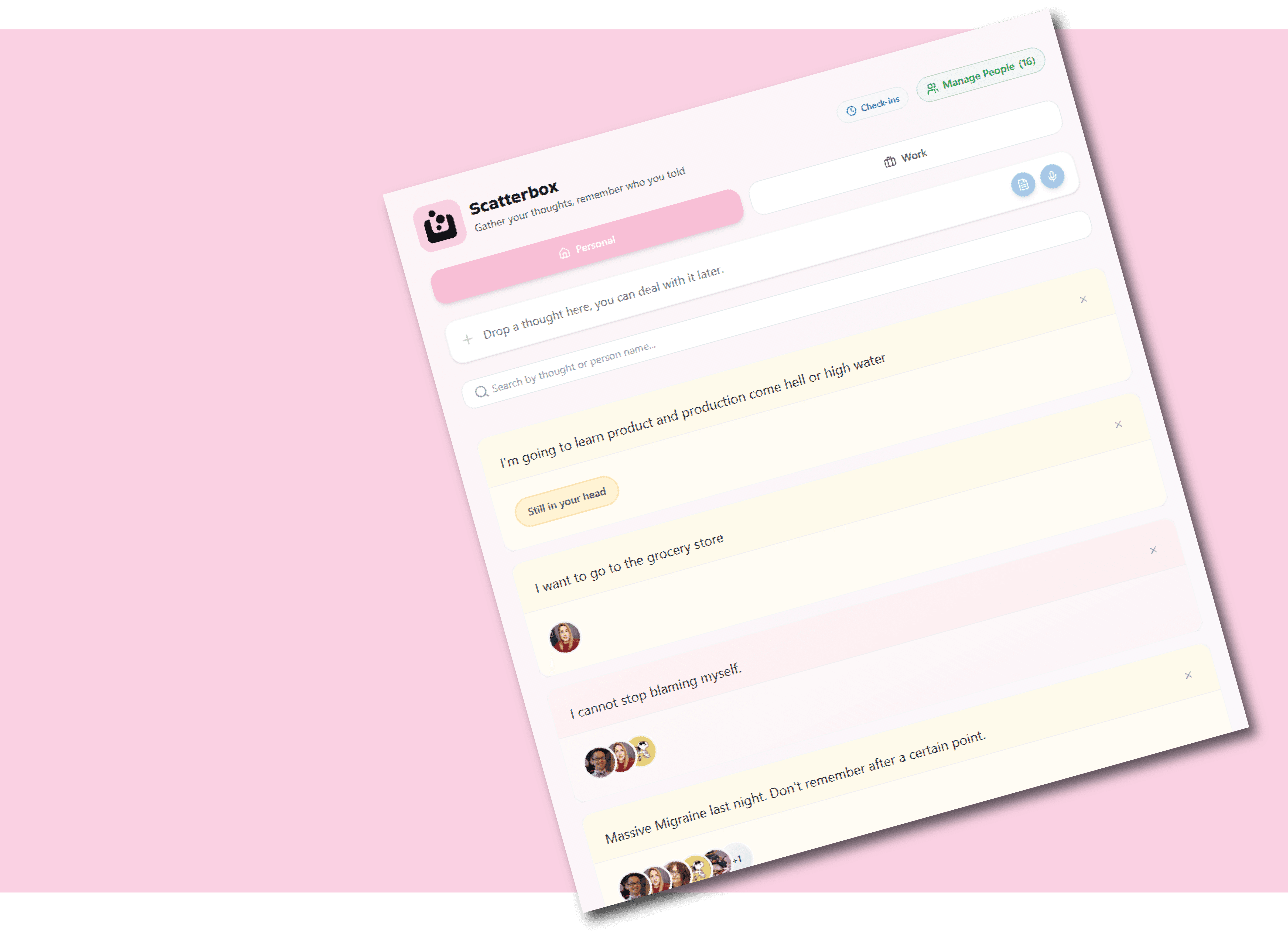
Problem 1: “I’ll remember this later” (and then… don’t)
ADHD brains generate valuable ideas constantly, but those thoughts are fragile. If they aren’t captured immediately, they’re gone — which leads to frustration, self-blame, and a sense of lost potential.
Solution
The app allows instant, low-friction thought capture with no required structure. Ideas can be recorded as-is, without deciding whether they’re tasks, notes, or “important enough.”
Impact
Users stop losing ideas — and stop blaming themselves for losing them.
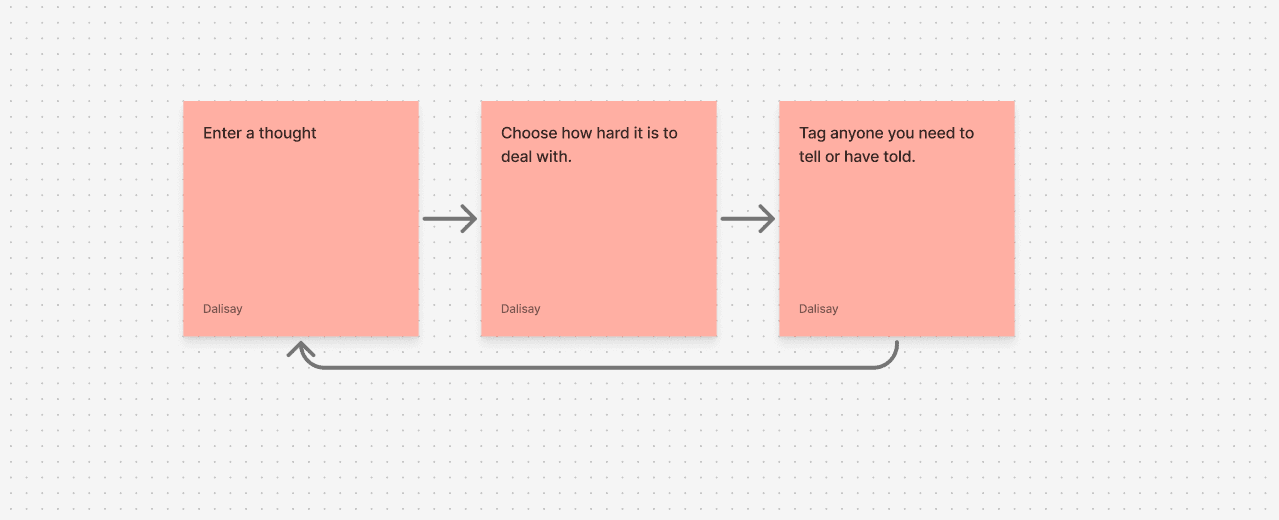
Problem 2: Cognitive overload from deciding where things belong
Most tools ask users to categorize, prioritize, and organize before capture. For ADHD users, that decision-making cost is often higher than the act of thinking itself.
Solution
Thoughts are stored as flexible “cards” that don’t demand classification up front. Organization can happen later — or not at all.
Impact
Reduced mental friction, faster capture, and less avoidance.

Problem 3: Shame-driven productivity systems
Streaks, deadlines, and missed reminders often trigger shame and disengagement, especially for neurodivergent users.
Solution
The app removes performance metrics entirely. There are no streaks, penalties, or “you fell behind” signals.
Impact
Users re-engage on their own terms, without fear of failure.
Problem 4: Forgetting who you’ve told what
ADHD users often struggle to track social context — whether an idea has been shared, promised, or discussed — leading to anxiety, over-explaining, or social withdrawal.
Solution
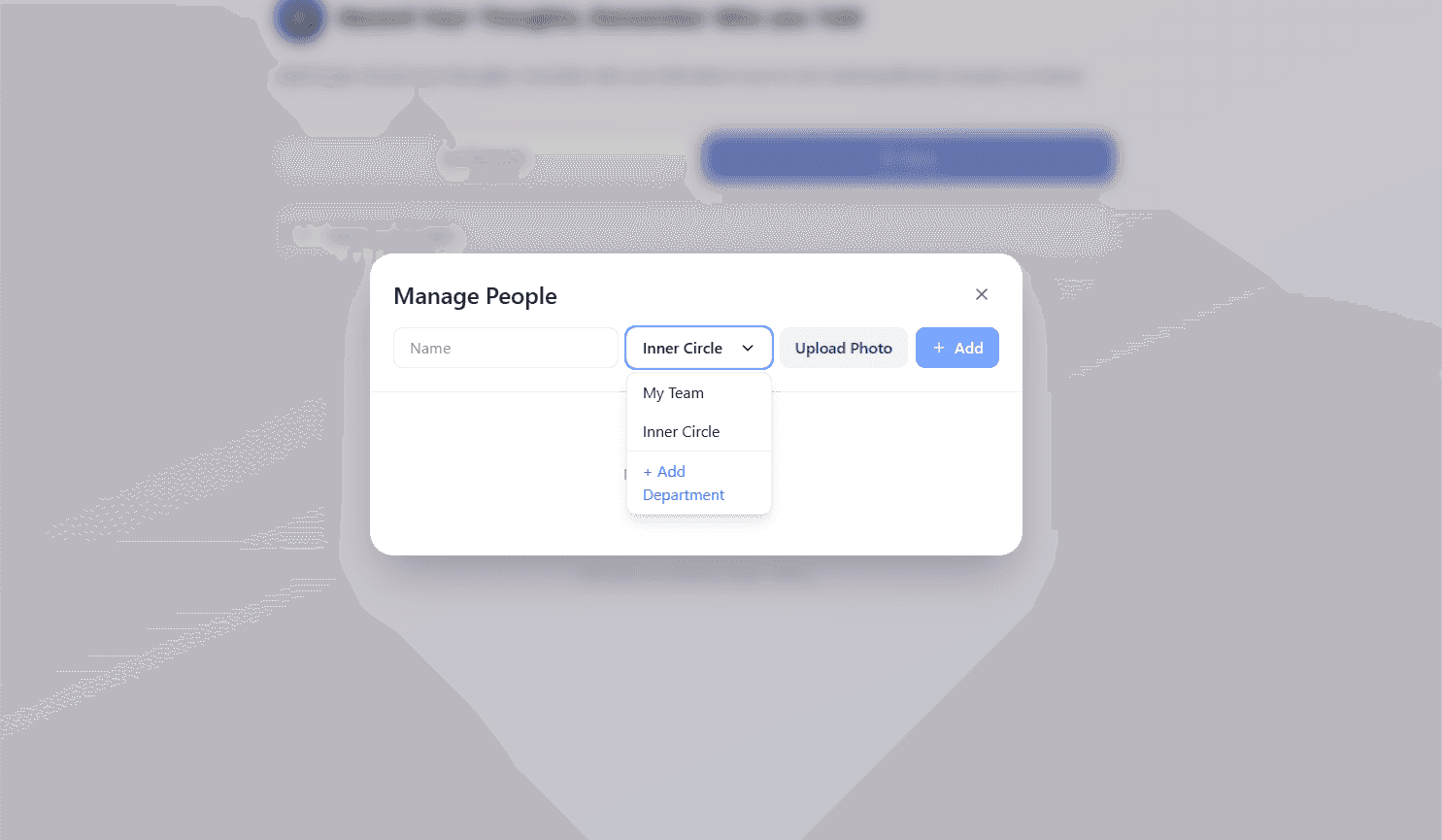
Thoughts can be tagged with people or groups, creating an externalized memory of social context.
Impact
Reduced social anxiety and fewer awkward or stressful follow-ups.
More Projects


Creative Direction
SCATTERBOX
This is an application developed by me entirely using Figma that remembers your disorganized thoughts so you can come back to them later, and remember who you told already.
Year :
2026
Industry :
App Design
Client :
Myself
Problem 1: “I’ll remember this later” (and then… don’t)
ADHD brains generate valuable ideas constantly, but those thoughts are fragile. If they aren’t captured immediately, they’re gone — which leads to frustration, self-blame, and a sense of lost potential.
Solution
The app allows instant, low-friction thought capture with no required structure. Ideas can be recorded as-is, without deciding whether they’re tasks, notes, or “important enough.”
Impact
Users stop losing ideas — and stop blaming themselves for losing them.
Problem 2: Cognitive overload from deciding where things belong
Most tools ask users to categorize, prioritize, and organize before capture. For ADHD users, that decision-making cost is often higher than the act of thinking itself.
Solution
Thoughts are stored as flexible “cards” that don’t demand classification up front. Organization can happen later — or not at all.
Impact
Reduced mental friction, faster capture, and less avoidance.
Problem 3: Shame-driven productivity systems
Streaks, deadlines, and missed reminders often trigger shame and disengagement, especially for neurodivergent users.
Solution
The app removes performance metrics entirely. There are no streaks, penalties, or “you fell behind” signals.
Impact
Users re-engage on their own terms, without fear of failure.
Problem 4: Forgetting who you’ve told what
ADHD users often struggle to track social context — whether an idea has been shared, promised, or discussed — leading to anxiety, over-explaining, or social withdrawal.
Solution
Thoughts can be tagged with people or groups, creating an externalized memory of social context.
Impact
Reduced social anxiety and fewer awkward or stressful follow-ups.
More Projects
Creative Direction
SCATTERBOX
This is an application developed by me entirely using Figma that remembers your disorganized thoughts so you can come back to them later, and remember who you told already.
Year :
2026
Industry :
App Design
Client :
Myself
Problem 1: “I’ll remember this later” (and then… don’t)
ADHD brains generate valuable ideas constantly, but those thoughts are fragile. If they aren’t captured immediately, they’re gone — which leads to frustration, self-blame, and a sense of lost potential.
Solution
The app allows instant, low-friction thought capture with no required structure. Ideas can be recorded as-is, without deciding whether they’re tasks, notes, or “important enough.”
Impact
Users stop losing ideas — and stop blaming themselves for losing them.
Problem 2: Cognitive overload from deciding where things belong
Most tools ask users to categorize, prioritize, and organize before capture. For ADHD users, that decision-making cost is often higher than the act of thinking itself.
Solution
Thoughts are stored as flexible “cards” that don’t demand classification up front. Organization can happen later — or not at all.
Impact
Reduced mental friction, faster capture, and less avoidance.
Problem 3: Shame-driven productivity systems
Streaks, deadlines, and missed reminders often trigger shame and disengagement, especially for neurodivergent users.
Solution
The app removes performance metrics entirely. There are no streaks, penalties, or “you fell behind” signals.
Impact
Users re-engage on their own terms, without fear of failure.
Problem 4: Forgetting who you’ve told what
ADHD users often struggle to track social context — whether an idea has been shared, promised, or discussed — leading to anxiety, over-explaining, or social withdrawal.
Solution
Thoughts can be tagged with people or groups, creating an externalized memory of social context.
Impact
Reduced social anxiety and fewer awkward or stressful follow-ups.